


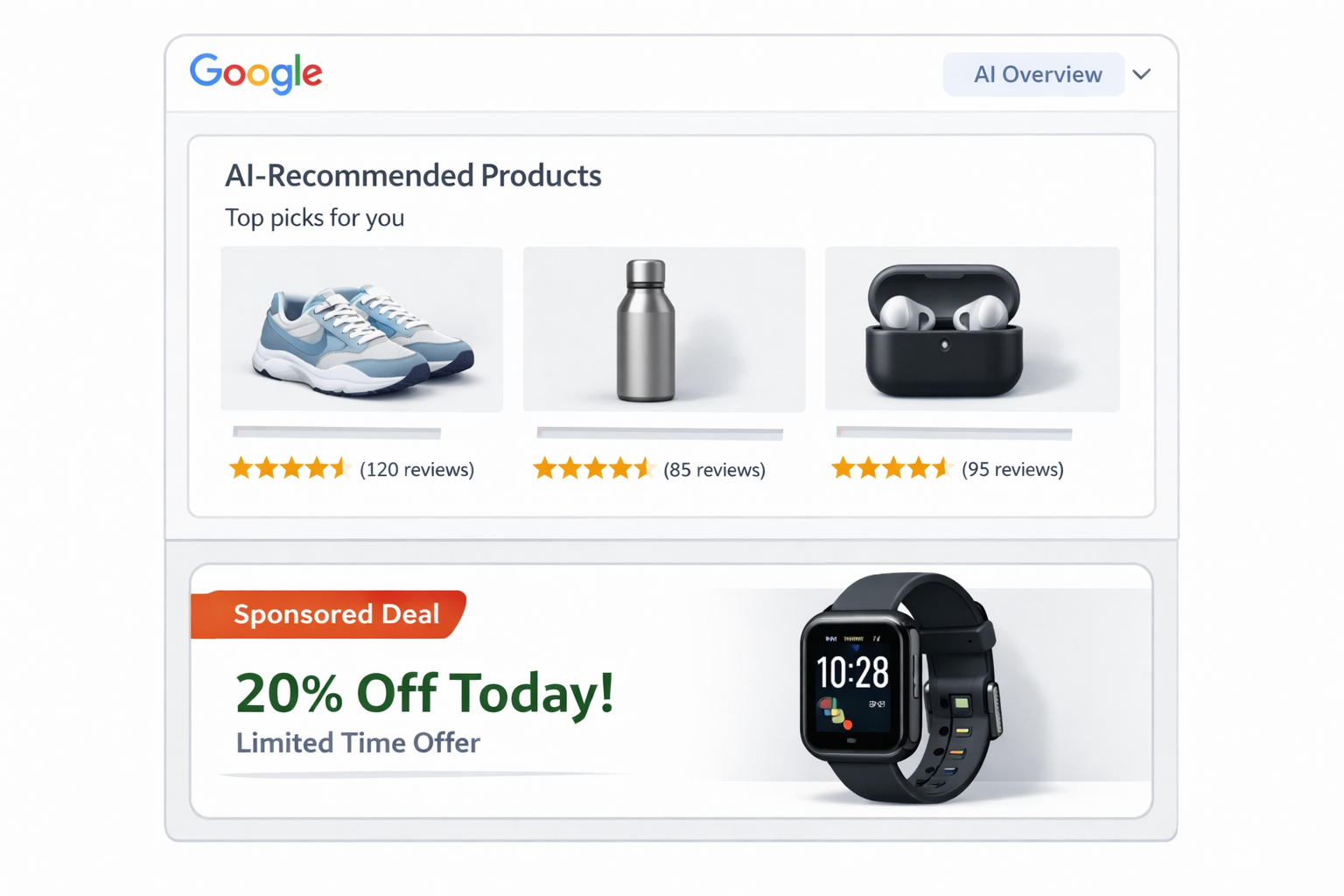
Google’s new AI Mode presents shoppers with an interactive, personalized mix of product recommendations, comparisons, and even direct purchase options right within the search results. The traditional list of blue links is replaced by a dynamic panel: you might ask for “a lightweight, sturdy travel stroller,” and Google’s AI returns a conversational answer along with specific product suggestions on the search page. It’s like a virtual personal shopper; the AI might note that “nylon is lighter for travel, but canvas lasts longer,” then show you strollers that match your needs (e.g. under your budget, in your style). The big question for brands and retailers:
How does Google decide which products make the cut organically, and how can you ensure yours are among them?
How Google Chooses Products in AI-Powered Search
Google’s AI-powered shopping results (whether in AI Overviews or the full AI Mode experience) are driven by Google’s Shopping Graph and a lot of data crunching. The Shopping Graph is Google’s real-time product database, now over 50 billion listings strong and refreshed more than 2 billion times per hour. In plain English: Google constantly ingests product info from across the web (your sites, feeds, reviews, etc.) and uses AI (Google’s Gemini model) to sift through it.
When a user’s query is submitted, Google’s AI interprets the intent and key specifics in natural language. It doesn’t just look for keyword matches. It looks for products that semantically fit the description. For example, ask “best waterproof travel bag for weekend trips”, and the AI will break that down behind the scenes (a technique called query fan-out) into sub-queries like “water-resistant materials,” “carry-on size,” “durable zippers,” “top travel brands,” etc. Each of those gets matched against Google’s Shopping Graph to find products meeting those criteria. By searching from multiple angles at once, Google’s AI can surface niche or highly relevant products that a traditional keyword search might miss.
What signals feed Google’s AI selection of organic products? It’s a mix of many factors, combining content and context:
- Product Feed Data: Google relies on the details in your Merchant Center feed (if you have one) – titles, descriptions, specs, pricing, availability, brand, etc. This structured feed info forms the backbone of the product panels that the AI displays. If your feed is sparse or outdated, you’re at a disadvantage.
- Website Schema Markup: Even if you’re not in Merchant Center, Google can parse product info from your site via structured data (Schema.org markup). Product schema markup – including price, availability, ratings, and more – makes it easier for Google’s AI to “understand” your item. It often cross-references feed data with site markup to ensure accuracy and get additional attributes.
- Contextual & Behavioral Signals: Google’s system learns from user behavior and context. Which products do people click or buy for similar queries? Are those items in stock and delivered quickly (what Google calls inventory confidence)? These behavioral and quality signals can influence which products the AI deems “relevant” and trustworthy. In short, products (and merchants) with a good track record have an edge.
- Visual Analysis: AI Mode is multimodal: it “sees” images too. Google analyzes product images (from your feed or site) to understand style, color, and other visual features. So, if a shopper uploads a photo or asks for “something that looks like [X]”, the AI can match it to visually similar products. High-quality, clear images with diverse angles can improve the AI’s ability to pair your product to visually-driven queries.
- Reviews & Ratings: Google’s shopping AI incorporates review data and overall merchant reputation into the mix. It might summarize common pros/cons from product reviews or consider a product’s star rating when deciding what to show. Similarly, a retailer’s reputation (e.g. ratings, return policy, shipping speed) can be a tiebreaker. Google wants to recommend products that will lead to happy customers, so social proof matters.
The result of this data stew provide highly context-aware product recommendations. Google’s AI isn’t just saying “here are running shoes”; it’s saying “here are running shoes that fit your specific query – like stability shoes good for knee issues, with high ratings, within your budget.” The takeaway: relevance in this new world is about holistic understanding of the product. To earn organic visibility, your product info needs to feed that understanding.
Optimize Your Product Data (Feeds + Schema)
If there’s one strategic move to glean from all this, it’s that product data quality is king. In the AI shopping era, Google effectively becomes an expert product matchmaker, but it can only recommend what it understands. As one deep-dive analysis put it, “only high-quality, machine-readable product data stays visible” in AI-driven search. In other words: garbage in, garbage out. If your product listings are thin on details, unstructured, or not kept current, Google’s AI may simply ignore them (or fail to recognize how they fit a user’s request).
So, how can you optimize your product data for maximum AI visibility? A few practical recommendations:
- Feed Google everything it needs (and more): Use Google Merchant Center (it’s free to list products organically) and supply a comprehensive feed. Don’t skimp on attributes: include clear titles, rich descriptions with benefits and use-cases, accurate categories, product types, GTINs, high-res images, and all relevant specs (dimensions, materials, compatibility, etc.). The new wave of Merchant Center attributes is expanding beyond basic keywords; Google is encouraging retailers to provide things like answers to common product questions, compatible accessories, and even substitute product suggestions in their data feeds. If these fields are available to you, fill them in. (Can your running stroller handle bumpy sidewalks? Does that camera come with a charger? What’s a good alternative if the item is out of stock?) This kind of info directly feeds the conversational answers Google’s AI can give.
- Leverage schema markup on your site: Implement structured data (Product schema, FAQ schema, etc.) on your product pages to reinforce and augment your feed. This is your way of saying to Google, “here’s exactly what this product is.” Include pricing, availability, review ratings (if applicable), and any key features. If you have an FAQ section on your product page (answering things like “Is this machine washable?”), mark it up with FAQ schema – those Q&As could be mined by Google’s model when users ask similar questions. The AI Overview in search often pulls in extra product details and specs directly from structured data on webpages, so this is an SEO step that now pays even bigger dividends.
- Keep data fresh and in sync: Make sure your feed updates as often as your inventory does. Google refreshes its Shopping Graph on a near-constant basis (billions of updates hourly), and it favours “live” info. An out-of-stock or mispriced item could get dropped from recommendations due to low inventory confidence. Use automatic item updates or content API to push real-time changes to Google. Consistency between your site and feed is also key; discrepancies (e.g. your site says 10 left in stock but feed says available) could hurt trust.
- Enrich product content for AI understanding: Think beyond basic bullet points. Add contextual content that a shopper (or AI) would find useful. For example, include a “Who this is for” or “Ideal use case” blurb in your descriptions. If you sell hiking boots, a line like “Ideal for rainy climates with its waterproof Gore-Tex lining” could directly answer a user’s AI query about “boots for wet weather.” These details might not be traditional SEO keywords, but they’re exactly the semantic cues AI thrives on. The goal is to anticipate what a curious shopper might ask and have that answered in your product info.
The overarching strategy is to make your product data complete, structured, and easily digestible by AI, ensuring your products genuinely deserve to be recommended for the right queries. When Google’s AI is confident that “this $99 black duffel meets all the criteria for a ‘durable waterproof weekender bag’,” that product is going to surface more often in the organic AI results.
Embrace Conversational Commerce with Business Agents
Another new factor in Google’s AI-powered shopping: some brands now have their very own AI Business Agent sitting right in Search.
What’s a Business Agent?
Essentially, it’s a branded AI chatbot that lets shoppers have a back-and-forth Q&A with a specific retailer, almost like chatting with a virtual sales associate who represents that brand. Google launched this in the U.S. with select retailers (Lowe’s, Michaels, Poshmark, Reebok, and others) as an opt-in feature via Merchant Center.
If a retailer activates a Business Agent, users might see an option on Search to “Chat with [Brand]”. This isn’t the general Google AI overview; it’s a one-on-one with the brand’s AI, in the brand’s voice. Shoppers can ask very specific questions about that retailer’s products, policies, or get personalized advice. For example, someone might ask the agent “I need paint for a humid climate: what do you recommend?” and get an answer referencing the brand’s inventory, complete with product suggestions.
For businesses, the organic visibility angle here is a bit different. A Business Agent won’t make your products magically appear in the AI results if they weren’t relevant to begin with. Google’s still going to pick the products it thinks best fit the query. However, if your brand is surfaced (or if a user specifically seeks your brand), the Business Agent can be a powerful tool to engage and convert that interest. It keeps the user on Google but within a brand-sanctioned experience where you can control the messaging and even offer special help or deals.
How to leverage Business Agents
If you’re an eligible retailer (currently larger U.S. retailers, with expansion expected), you can activate and customize your agent via Merchant Center. This includes defining your brand’s “voice” and providing data for it to use. In coming months, Google plans to let businesses train these agents on their own data and FAQs, offer personalized product recommendations, and even facilitate direct purchases within the chat. That means your agent could eventually handle everything from answering “Does this come in XXL?” to helping the customer check out with the item.
For now, even if you’re not in the initial rollout, it’s worth keeping an eye on this feature. It signals where things are headed: more conversational, two-way interactions at the top of the funnel. From a strategic standpoint, think about the common questions customers ask about your products and how you’d answer them conversationally. Those answers need to live in your data (feeds, site content) so that either Google’s AI or your own Business Agent can draw on them. The brands that succeed in the “conversational commerce” era will be those who speak the AI’s language and the customer’s language, seamlessly.
Organic vs. Paid: Direct Offers and the New AI Ads
No discussion of Google visibility is complete without touching on the paid side. Google’s generative AI search experience is still search, which means Google is figuring out how to monetize it without ruining the user experience. Enter Direct Offers – a new pilot ad format specifically for AI-powered results. This is basically Google giving advertisers a chance to put an exclusive deal or discount right into the AI shopping overview, when a user is showing high purchase intent.
Here’s how it works (currently in testing): Suppose you search for something in AI Mode, like the example Google gave: “modern stylish rug for a high-traffic dining room… easy to clean”. The AI overview will do its thing and organically highlight a few relevant products that meet your criteria (material, style, durability, etc.) – these are unpaid, algorithmically chosen results. Now, with Direct Offers, retailers who sell those relevant products can inject a special offer, like “Get 20% off this rug at [Retailer] if you buy now.” This appears within the AI result as a “Sponsored deal” label. It’s an ad tied to a product the AI already thinks you might want, but it gives you an extra nudge with a discount. The user benefits (who doesn’t love a deal?), and the retailer pays Google for that ad placement if the user engages.
This marks an important distinction between organic inclusion vs. paid visibility in AI results:
- Organic product picks are free – you can’t pay to be one of the AI’s chosen recommendations. Your only path in is to earn it via relevance (which, as we discussed, comes from robust data and a good fit for the query). Google even notes that in AI Mode “it already elevates the most relevant products” for the user’s search. Think of this like the new SEO for shopping: if your product is the best answer, it gets featured without you paying a dime.
- Paid offers (Direct Offers) are sponsored enhancements. They don’t replace the organic picks; they augment them when applicable. You’re essentially bidding to say, “If my product is shown, highlight my special deal to make it more enticing.” These are clearly labeled as ads (e.g. “Sponsored deal”) to maintain transparency. In practice, having a compelling offer could sway a shopper to choose your listing over a competitor’s in the AI list. It’s a new twist on competition: even if two brands’ products both show up organically, one might also have a 20% off tag that draws the click first.
For marketers, the immediate action item is to stay informed on these ad experiments. Standard Shopping Ads and Performance Max campaigns still exist and will likely continue to show in various forms around the AI results. But Google is clearly exploring formats that blend into the conversational experience (while keeping disclosure). Direct Offers are one such format, currently limited to select advertisers. If you’re invited or see it rolled out, consider testing it, especially if you can afford to dangle an attractive promo. It could be the difference between a user scrolling past your product versus clicking “Add to cart.” Just remember that no amount of ad spend will help if your product data is weak; paid deals can amplify relevance, not create it from thin air.
Strategic Takeaways
Google’s AI-driven shopping is a game-changer, as it raises the bar for what it takes to win organically. Here’s the tl;dr for succeeding:
- Feed the AI rich data: The brands winning organic slots are those with complete, structured, and context-rich product information. Audit your Merchant Center feeds and on-page markup now – are they telling a compelling, machine-readable story about your products? If not, start beefing them up (think detailed attributes, FAQs, lifestyle info). Remember, “The quality of product data will decide whether a product is found and recommended”.
- Optimize for people (via AI): Google’s generative AI is essentially trying to mimic a helpful human salesperson at scale. Think about the criteria a savvy shopper or store associate would consider for your product (“Is this compatible with X?”, “Great for beginners?”, “Eco-friendly material?”) and make sure those angles are covered in your content. The AI will reward you by knowing exactly when your product is the answer to a user’s nuanced query.
- Embrace new tools early: If features like Business Agents or UCP (Universal Commerce Protocol) are available to you, take advantage. Business Agents give you direct conversational reach to customers on Google, a new organic touchpoint that can drive engagement and sales in critical “moment of decision” scenarios. And UCP, which underpins agentic checkout, lets users buy from you instantly in AI search results. Early adopters often gain a leg up (and valuable data/learnings) before these features become mainstream.
- Watch the paid/organic interplay: Keep a close eye on how paid placements (like Direct Offers) evolve in AI results. Organic inclusion gets you there, but a smart ads + offers strategy can seal the deal. That said, maintain a clear distinction in your metrics and mindset: organic AI visibility is an SEO/content/data challenge, whereas converting that visibility might involve promotional tactics. Don’t assume paying will solve an organic deficiency; use it to complement an already-strong presence.
In a nutshell, succeeding in Google’s AI-powered shopping means combining classic ecommerce fundamentals with new AI-era tactics. It’s about having the right data (and plenty of it), structured for machines yet appealing to humans, and staying agile as Google rolls out new ways to connect shoppers with products. The brands that get this right will find themselves in a very enviable spot: front-and-center in the next generation of search, answering customers’ needs before the competition even figures out what happened.